Preventive maintenance is most effective when it is simple, repeatable, and based on trends. Industrial motors should not be opened or removed without a reason, but routine visual, electrical, mechanical, and operating checks can reveal deterioration before it becomes an outage. Use the checklist below as a starting point and adjust the frequency for duty, environment, and criticality.
Monthly visual and operating checks
- Keep cooling openings, fan covers, and external surfaces clean.
- Listen for new rubbing, clicking, humming, or bearing noise.
- Check for oil, water, dust, or chemical contamination.
- Look for loose connections, damaged conduit, and overheated terminals.
- Record unusual odors, paint discoloration, or hot spots.
Electrical condition checks
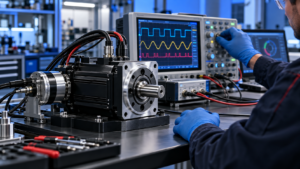
Measure and compare phase current and voltage under a stable load. Investigate imbalance rather than accepting it as normal. Trend insulation resistance using consistent test voltage, motor temperature, and environmental conditions. Inspect terminal connections and grounding, and use thermography where appropriate.
Mechanical condition checks
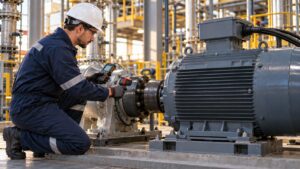
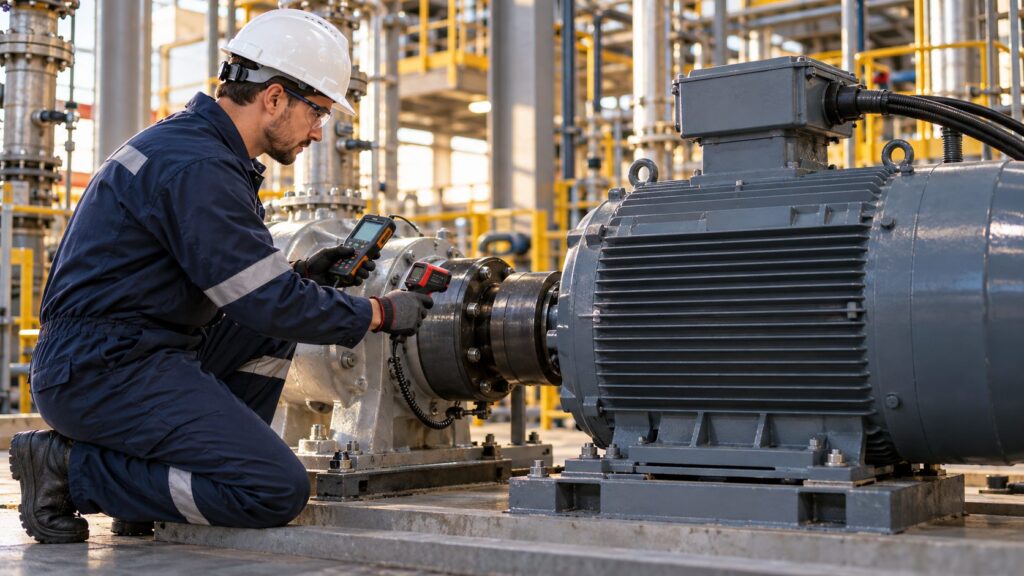
Record vibration at consistent locations and operating conditions. Monitor bearing-housing temperature, follow the correct lubrication interval, and use the specified grease type and quantity. Inspect coupling alignment, belts, guards, mounting bolts, foundation condition, and soft foot. Small mechanical changes often appear before a failure is audible.
Review the application
Confirm that the motor is not operating above nameplate load, starting too frequently, or running with restricted cooling. Changes in production rate, driven equipment, ambient temperature, or contamination can shorten motor life even when the motor itself has not changed.
Trend data instead of relying on one reading
A single vibration, temperature, or insulation reading is only a snapshot. Record dates, load, ambient conditions, and test methods so values can be compared. A gradual change can justify planned inspection long before an alarm limit is reached.
When should a motor be removed from service?
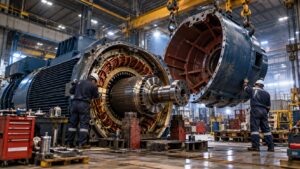
Plan an outage when you find rapidly increasing vibration or temperature, severe current imbalance, declining insulation resistance, repeated trips, visible arcing, unusual shaft movement, or contamination that cannot be corrected in place. Early removal can protect the core, shaft, rotor, and driven equipment.
Prepare for repair before a failure
Maintain accurate nameplate records, critical dimensions, spare-motor availability, lifting requirements, and pickup contacts. For essential equipment, establish the repair scope and communication process before an emergency occurs.
Need help building a motor maintenance and repair plan? USA Motor Repair provides inspection, testing, rewinding, mechanical rebuilds, and nationwide pickup support. Call (909) 247-3610 to discuss your critical motors.